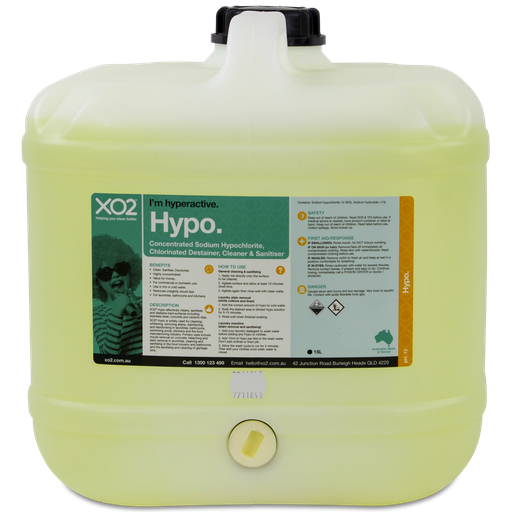
Specifications for Hypo - Concentrated Sodium Hypochlorite - Chlorinated Destainer, Cleaner & Sanitiser
I'm hyperactive.
Hypo (Sodium Hypochlorite/Chlorine) effectively cleans, sanitises and destains hard surfaces including stainless steel, concrete and ceramic tiles. Hypo has numerous commercial, industrial and domestic applications.
Where to use
Hypo is highly concentrated and widely used for cleaning, whitening, removing stains, disinfecting and deodorising in laundries, bathrooms, swimming pools, kitchens and the food manufacturing industry. The primary uses include mould removal on concrete, bleaching and stain removal in laundries, cleaning and sanitising in the food industry and bathrooms, and the sanitising and cleaning of garbage bins.
Hypo can be used indoors and outdoors in multiple applications including:
• Food preparation and manufacturing plants, commercial kitchens, butcheries, abattoirs, fisheries etc: An outstanding cleaner and de-stainer for use on all resistant washable surfaces and it effectively eliminates odours too.
• Outdoor areas and externals of buildings: Ideal for cleaning and removing stains and discolouration from all outdoor washable surfaces including roofs, shade sails and outdoor furniture.
• Washrooms, toilets and bathrooms: Ideal for sanitising, cleaning and whitening washable surfaces. Effectively removes unsightly mould and mildew.
The benefits
• Clean. Sanitise. Deodorise.
• Highly concentrated.
• Value for money.
• For commercial or domestic use.
• Use in hot or cold water.
• Removes unsightly mould fast.
• For laundries, bathrooms and kitchens.
• Australian-made and owned.
When diluting, always add Hypo to water. Not recommended for silks, woollens, nylon, rayon, coloured goods, drip-dry fabrics, leather, stained or varnished surfaces.
General cleaning and sanitising
- Dilute at 80:1 (80 parts water to 1 part Hypo). That's approximately 99% water and 1% Hypo (50ml of Hypo in ½ a bucket/4 litres of water or 13ml per litre). Add water to your bucket, then add Hypo. For lighter applications, dilute at 200:1 (200 parts water to 1 part Hypo) and for mould removal, dilute at 40:1
(40 parts water to 1 part Hypo).
- Apply directly onto the surface to be cleaned.
- Agitate the surface and allow at least 10 minutes of dwell time.
- Agitate again then rinse well with clean water.
Sodium Hypochlorite 10% Dilution Table (ppm)
- 10ml/Litre = approx. 1000ppm chlorine
- 8ml/Litre = approx. 800ppm chlorine
- 5ml/Litre = approx. 500ppm chlorine
- 3ml/Litre = approx. 300ppm chlorine
- 2ml/Litre = approx. 200ppm chlorine
- 0.1ml/Litre = approx. 10ppm chlorine
Laundry stain removal (white cotton and linen)
- Add the correct amount of Hypo to cold water. Dilute at 64:1 (64 parts water to 1 part Hypo). That's approximately 98.5% water and 1.5% Hypo (15ml per litre). Add water to your bottle or bucket, then add Hypo.
- Soak the stained area in diluted Hypo solution for 5 to 15 minutes.
- Rinse well when finished soaking.
Laundry soaking (stain removal and sanitising)
- Add the correct amount of Hypo to cold water. Dilute at 64:1 (64 parts water to 1 part Hypo). That's approximately 98.5% water and 1.5% Hypo (60ml of Hypo in ½ a bucket/4 litres of water or 15ml per litre). Add water to your bucket, then add Hypo.
- Mix solution well, add clothes and allow to soak for 2 to 3 hours.
- Rinse well when finished soaking.
Laundry machine (stain removal and sanitising)
- Add your laundry detergent to wash water before adding any Hypo or clothes.
- Add 15ml of Hypo per litre to the wash water. Don't add clothes or linen yet.
- Allow the wash cycle to run for 5 minutes. Then add your clothes once the wash water is mixed.
Handy tips and laundry advice
- Better wash results are always obtained with warm to hot water.
- The quantity of Hypo required will vary depending on the nature and degree of soiling, as well as the wash temperature.
- Read and follow garment washing instructions.
- Wash colours separately.
- If in doubt, test the colour fastness of garments before use.
- For best results use freshly diluted cleaning solutions.
- Always test first in an inconspicuous area before using any cleaning solution. Play it safe, especially when you use a product for the first time. Better to be safe than sorry. Some surfaces and fibres can be sensitive to moisture and particular chemical types.
- When manually filling bottles, buckets or tanks, add the water first and the chemical last. This prevents foaming, chemical splashes and spills.
What is Hypo used for?
It cleans, whitens, removes stains, disinfects and deodorises in laundries, bathrooms, swimming pools, kitchens and the food manufacturing industry. The primary uses are mould removal on concrete, bleaching and stain removal in laundries, cleaning and sanitising in the food industry and bathrooms, and sanitising and cleaning garbage bins.
How do I dilute Hypo?
For general cleaning and sanitising, dilute at 80:1 (80 parts water to 1 part Hypo). For lighter applications use 200:1, and for mould removal use 40:1. For laundry stain removal and soaking, use 64:1. When diluting, always add Hypo to water.
How do I remove mould with Hypo?
Dilute at 40:1 and apply directly onto the surface. Agitate the surface and allow at least 10 minutes of dwell time, then agitate again and rinse well with clean water.
How do I remove stains from white cotton and linen with Hypo?
Add Hypo to cold water at 64:1 (about 15ml per litre), soak the stained area for 5 to 15 minutes, then rinse well. To soak and sanitise a load, mix at 64:1, add the clothes and soak for 2 to 3 hours, then rinse well.
How much Hypo do I use in the washing machine?
Add your laundry detergent to the wash water first. Then add 15ml of Hypo per litre of wash water, without any clothes. Let the wash cycle run for 5 minutes, then add your clothes.
How do I work out the ppm of chlorine?
For Sodium Hypochlorite 10%,
- 10ml/Litre = approx. 1000ppm chlorine
- 8ml/Litre = approx. 800ppm chlorine
- 5ml/Litre = approx. 500ppm chlorine
- 3ml/Litre = approx. 300ppm chlorine
- 2ml/Litre = approx. 200ppm chlorine
- 0.1ml/Litre = approx. 10ppm chlorine
What shouldn't I use Hypo on?
It's not recommended for silks, woollens, nylon, rayon, coloured goods, drip-dry fabrics, leather, or stained or varnished surfaces. Test first, wash colours separately and test the colour fastness of garments if you're in doubt.
Should I use hot or cold water?
Either works. For laundry, better wash results are always obtained with warm to hot water, and the amount of Hypo you need varies with the soiling and the wash temperature.
What's the best way to fill a bucket or bottle with Hypo?
Add the water first and Hypo last. This prevents foaming, chemical splashes and spills. For best results, use freshly diluted cleaning solutions.
Still not sure which XO2 product is right for your site? Give us a call on 1300 123 499. No hard sell, just help.
Safety Data Sheet
Wall Charts
Related Articles
Calculators