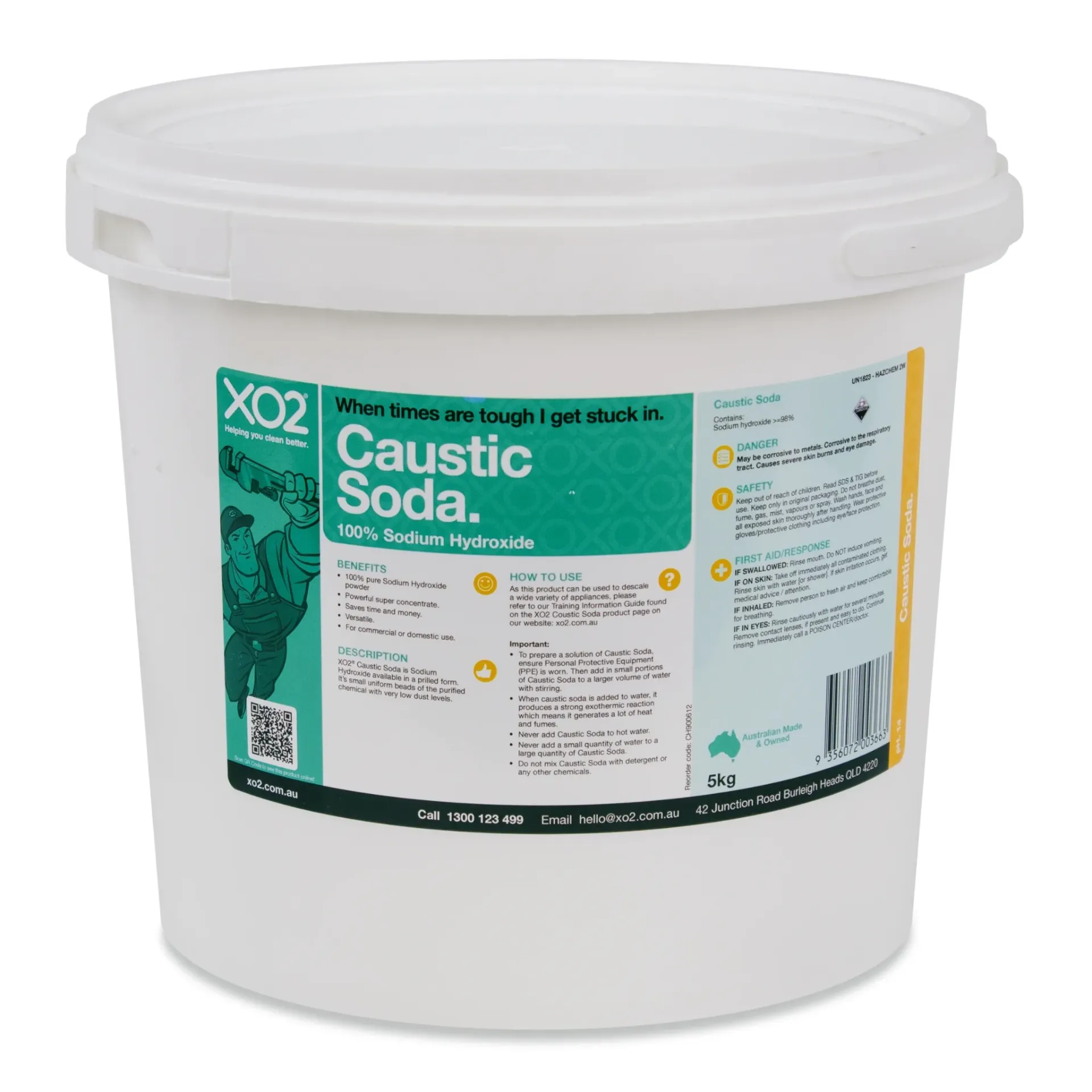
Specifications for Caustic Soda - Sodium Hydroxide, 100% Pure Prills
When times get tough I get stuck in.
Caustic Soda is 100% pure Sodium Hydroxide available in a prilled form. That is small uniform beads of the purified chemical with very low dust levels.
Where to use
Sodium hydroxide is the principal strong base used in the chemical industry. It is also used for heavy-duty and industrial cleaning. Caustic Soda has many applications!
Caustic Soda has many applications which include...
• Soap production: Sodium hydroxide is traditionally used in soap making (cold process soap, saponification).
• Biodiesel: For the manufacture of biodiesel, sodium hydroxide is used as a catalyst for the transesterification of methanol and triglycerides.
• Aluminium etching: Strong bases attack aluminium. Sodium hydroxide reacts with aluminium and water to release hydrogen gas. In this reaction, sodium hydroxide acts as an active catalyst. This reaction can be useful in etching, removing anodizing, or converting a polished surface to a satin-like finish, but without further passivation such as anodizing or alodining the surface may become degraded, either under normal use or in severe atmospheric conditions.
• Cleaning agent: Sodium hydroxide is frequently used as an industrial cleaning agent and it is often called "caustic". It is added to water, heated, and then used to clean the process equipment, storage tanks, etc. It can dissolve grease, oils, fats and protein-based deposits. The sodium hydroxide solution can also be added to surfactants to stabilize dissolved substances to prevent redeposition. A sodium hydroxide soak solution is used as a powerful degreaser on stainless and glass bakeware. It is also a common ingredient in oven cleaners.
• Leaded glass window restoration: Sodium Hydroxide can be used to dissolve old "weatherproofing cement" in leaded glass windows by soaking the panels overnight in a solution of Sodium hydroxide.
• Paint stripping: A solution of sodium hydroxide in water was traditionally used as the most common paint stripper on wooden objects. Due to its caustic nature and the fact that it can damage the wood surface raising the grain and staining the colour, its use has become less common.
• Drain Cleaning: Sodium hydroxide is used in the home and commercial sites as a drain cleaning agent for clearing clogged drains. It is distributed as a dry crystal or as a thick liquid gel. The chemical mechanism employed is the conversion of grease to a form of soap. Soap is water-soluble, and can be dissolved by flushing with water. This conversion occurs far more rapidly at high temperatures, so commercial drain cleaners may also contain chemicals that react with water to generate heat. Sodium hydroxide also decomposes complex molecules such as the protein that composes hair. Such drain cleaners (and their acidic versions) are highly caustic and should be handled with care.
The benefits
• 100% pure Sodium Hydroxide powder.
• Powerful super concentrate.
• Saves time and money.
• Versatile.
• For commercial or domestic use.
Important
▪ When caustic soda is added to water, it produces a strong exothermic reaction which means it generates a lot of heat and fumes.
▪ Never add Caustic Soda to hot water.
▪ Never add a small quantity of water to a large quantity of Caustic Soda.
▪ Do not mix Caustic Soda with detergent or any other chemicals.
• Always use fresh solutions daily.
• Always read and adhere to the Safety Data Sheet (SDS.)
Use as required.
Caustic Soda instructions
To prepare a solution of Caustic Soda, ensure Personal Protective Equipment (PPE) is worn. Then add in small portions of Caustic Soda to a larger volume of water with stirring.
Warning
- When caustic soda is added to water, it produces a strong exothermic reaction which means it generates a lot of heat and fumes.
- Never add Caustic Soda to hot water.
- Never add a small quantity of water to a large quantity of Caustic Soda.
- Do not mix Caustic Soda with detergent or any other chemicals.
- Always use fresh solutions daily.
Handy tips
- Always test first in an inconspicuous area before using any cleaning solution. Play it safe, especially when you use a product for the first time. Some surfaces can be sensitive to moisture and particular chemical types.
What is Caustic Soda used for?
Heavy-duty and industrial cleaning, soap production, drain cleaning, aluminium etching, biodiesel manufacture, leaded glass window restoration and paint stripping. Paint stripping on wood has become less common because the caustic can raise the grain and stain the colour.
How do I prepare a caustic soda solution?
Wear PPE, then add small portions of Caustic Soda to a larger volume of water, stirring as you go. Please check the SDS and your site's procedures.
Why does the water get hot?
When caustic soda is added to water, it produces a strong exothermic reaction, which means it generates a lot of heat and fumes.
Can I add Caustic Soda to hot water?
No. Never add Caustic Soda to hot water.
Can I add a little water to a large quantity of Caustic Soda?
No. Never add a small quantity of water to a large quantity of Caustic Soda.
Can I mix Caustic Soda with detergent or other chemicals?
No. Don't mix Caustic Soda with detergent or any other chemicals.
How long does a Caustic Soda solution last?
Always use fresh solutions daily.
What does 'prilled' mean?
Small uniform beads of the purified chemical, with very low dust levels.
Is Caustic Soda safe on aluminium?
No. Strong bases like Caustic Soda attack aluminium. Sodium hydroxide reacts with aluminium and water to release hydrogen gas, and without further treatment the surface may become degraded.
Where can I find the safety information for Caustic Soda?
Always read and adhere to the Safety Data Sheet (SDS).
Still not sure which XO2 product is right for your site? Give us a call on 1300 123 499. No hard sell, just help.
Safety Data Sheet
Wall Charts
Related Articles
Calculators