- All products
- Cleaning Products
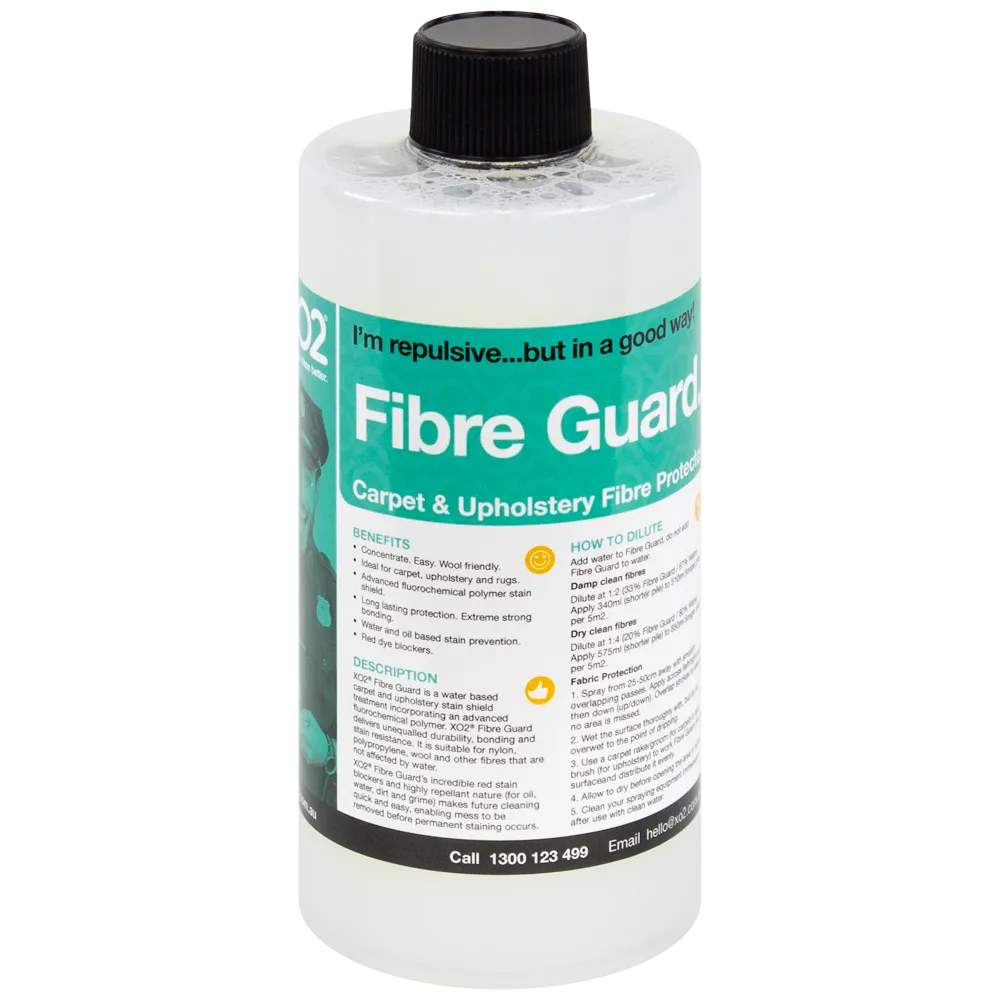
- Fibre Guard - Carpet & Upholstery Fabric Protector
- Cleaning Products


Specifications for Fibre Guard - Carpet & Upholstery Fabric Protector
| Size | 500ml or 5L |
Protect it once. Clean it easier.
Fibre Guard is XO2's professional-grade water-based fabric protector for carpet, upholstery, rugs and drapes. It's a stain shield with incredible red stain blockers and a highly repellent nature for oil, water, dirt and grime. Fibre Guard makes future cleaning quick and easy, so you can remove a mess before it becomes a permanent stain.
Why You'll Love It
- Repels stains - water and oil-based stain prevention, with red dye blockers.
- Beads water - high beading water repellency makes spills easier to clean up.
- Long-lasting - durable protection even under heavy traffic, with extremely strong bonding.
- Easier to clean - when soils can't penetrate or bond to the fibre, your carpets and upholstery naturally look cleaner and newer for longer.
- Wool-friendly - and it suits nylon, polypropylene and other fibres that aren't affected by water.
- Healthy indoor environment - the microfilm repels dust mites and allergens, releasing them for effective removal by regular vacuuming with a HEPA vacuum cleaner. It's hypoallergenic: the inert microfilm is not a known cause of any skin or respiratory irritation to adults, children or pets.
- Concentrated and economical - an easy spray method, and a low-VOC, safer water-based formula. It's odourless and formulated using ultra vapour technology, so it's safe and easy to apply.
Free-From and Environment
- Safe for humans and surfaces, and pet-friendly.
- Low-VOCs.
- No colour dyes added.
- 100% cruelty-free and never tested on animals.
- Eco-friendly and 100% biodegradable.
- Zero carcinogens.
- Non-flammable. Non-DG (Not Dangerous Goods).
Best For...
- Protecting fibres after deep cleaning
- Protecting new carpet, upholstery and rugs
- Nylon, polypropylene and wool fibres
- High-traffic areas
- Adding fabric protection to a carpet cleaning service
Industries:
- Professional Carpet & Upholstery Cleaners
- Hotels
- Offices
- Nursing Homes
- Restaurants & Clubs
- Cinemas & Conference Centres
- Homeowners
Where You Can Use It
Areas:
Homes, offices, hotel rooms, nursing homes, restaurants, clubs, cinemas, conference centres and car seats: carpet, upholstery, rugs and drapes.
Surfaces:
Domestic and commercial carpets, upholstery, rugs, drapes and other water-cleanable fibres, including nylon, polypropylene and wool.
Important: Not suitable for some delicate fibres and dry-clean-only materials, where a solvent-based fabric protector may suit better. If the fabric is water cleanable, it's safe to protect with a water-based protector. No fibre protector is 100% bulletproof, so clean up spills straight away. Always test in an inconspicuous area first. Never mix a fabric protector with other chemicals. Discard diluted solutions more than 24 hours old.
Is Fibre Guard Right For Me?
Choose Fibre Guard if you want:
- A water-based fabric protector for carpet, upholstery and rugs
- A wool-friendly, low-VOC protector
- Long-lasting protection under heavy traffic
- A concentrate you spray on damp or dry fibres
- A protector that doesn't affect fire-resistant fabrics
Choose another XO2 product if:
- You want a neutralising rinse, softener and cleaner for carpet > Plush (Neutralising Rinse, Softener, Cleaner & Odour Treatment for Carpet, Rugs & Upholstery)
- You need to remove a stain from carpet or upholstery first > Houdini (The Amazing Stain Remover For Carpet & Upholstery)
What Makes It Different?
- Advanced Fluorochemical Polymers - an invisible stain shield with strong bonding.
- Water-Based and Low-VOCs - a safer water-based formula.
- Red Dye Blockers - plus water and oil-based stain prevention.
- Easy Spray Method - works on damp or dry fibres.
- Safe on Fire-Resistant Fabrics - it doesn't affect them.
- Australian-Made and Owned Since 1968 - a family business that answers the phone.
How Far Does It Go?
Damp fibres (1 part Fibre Guard to 1.5 parts water)
- 200ml Fibre Guard makes 500ml of ready-to-use solution
- 300ml Fibre Guard makes 750ml of ready-to-use solution
- 400ml Fibre Guard makes 1L of ready-to-use solution
- 2L Fibre Guard makes 5L of ready-to-use solution
Dry fibres (1 part Fibre Guard to 4 parts water)
- 100ml Fibre Guard makes 500ml of ready-to-use solution
- 150ml Fibre Guard makes 750ml of ready-to-use solution
- 200ml Fibre Guard makes 1L of ready-to-use solution
- 1L Fibre Guard makes 5L of ready-to-use solution
Specifications
Type: Water-based fluorochemical polymer fabric protector (stain shield)
Fibre suitability: Nylon, polypropylene, wool and other fibres not affected by water
pH: 5.5–6.5 (concentrated form)
Repellency: Water, oil, dirt and grime
VOC: Low
Fire-resistant fabrics: Not affected
Wool-friendly: Yes
Fabric Protector Calculator
XO2® recommends Fibre Guard fabric protector concentrate. This calculator is based on Fibre Guard's cost, dilution, application and usage rates.
Section 1
Usage
1. What are you protecting?
Long pile carpet has more fibre to coat, so it takes about 50% more product per m² than short pile. Upholstery uses the short-pile rate.
2. How many applications?
Single application is for regular fabric protection treatments on carpet and upholstery. A double application of fabric protector is recommended for high traffic lanes on carpet and heavily used upholstery.
3. Are the fibres damp or dry?
Damp fibres take a stronger mix (40% Fibre Guard / 60% water) because the moisture already in the fibres dilutes it further. Dry fibres use a weaker mix (20% / 80%) applied more heavily.
4. Carpet area
Pick a typical job or type your own area. Length × width for each room, added together.
4. Seating positions
Number of seats
Fabric per seat
Pick a furniture type to fill in the fabric per seat (lounges also fill in the number of seats), then adjust either number to suit the job. For dining and office chairs, enter how many chairs you're protecting. 3 m² per seat covers the seat, back, arms and sides of a typical lounge.
Section 2
Earnings
1. Your product cost
Change the price above if you pay a different price.
2. Your on-sell price
All prices include GST. Application time excludes set-up and clean-up.
Handy advice
- Offer a special discount if you clean the carpets first — protecting damp, freshly cleaned fibres is quick and uses the stronger, more economical mix.
- Offer high-traffic or problem areas as an option — hallways, entries and lounge seats are an easy add-on.
- Working to a budget? If the customer only has $100 to spend, mix up that much product and cover as much area as possible.
- Charge more for new carpet you didn't clean — most technicians do, as it's a stand-alone visit on dry fibres.
- Groom after applying — use a carpet groomer or rake in both directions on carpet, and a soft brush in both directions on upholstery.
- Don't cut corners — this is very profitable work, so you can afford to be generous with your product use.
XO2® Fibre Guard application rates
Application rates are for ready-to-use (diluted) product. Application speed depends on your spray equipment and how complex the furniture is.
How to use Fibre Guard
Fibre Guard can be applied to damp or dry carpet and upholstery to help protect fibres against water and oil-based stains.
1. Prepare the surface
Ensure the carpet or upholstery is clean and free from dirt, stains and cleaning chemical residues.
New carpet and upholstery may not require pre-cleaning.
Always test Fibre Guard on an inconspicuous area first to check for colourfastness and material compatibility.
2. How to dilute Fibre Guard
Important: Always add water to Fibre Guard, not Fibre Guard to water. Dilution ratios are expressed as parts water to parts Fibre Guard.
| Fibre Condition | Dilution | Water | Fibre Guard | Application per 5m² per coat |
|---|---|---|---|---|
| Damp fibres | 1.5:1 | 60% | 40% | 340–510ml |
| Dry fibres | 4:1 | 80% | 20% | 575–850ml |
Application rates:
Shorter pile: Use the lower application rate.
Longer pile: Use the higher application rate.
All application amounts refer to the total diluted, ready-to-use solution.
3. How to apply Fibre Guard
Prepare your sprayer. Use a low-pressure pump-up or electric sprayer. The recommended application pressure is 30–50psi, using an 80-04 spray nozzle (80° spray angle / 04 flow rating) or similar.
Spray evenly. Hold the nozzle approximately 25–50cm from the surface. Apply Fibre Guard using smooth, overlapping passes, first from left to right, then up and down, to achieve uniform coverage.
Avoid over-wetting. Apply the recommended amount without saturating the fibres. Two light passes are preferable to one heavy application.
Work it into the fibres. Use a carpet rake for carpet or a soft upholstery brush for fabric to help distribute Fibre Guard evenly, particularly on thick pile and textured surfaces.
Apply a second coat if required. For high-traffic areas or where additional protection is desired, apply a second light coat, allowing appropriate time between applications.
Allow to dry and cure. Fibre Guard is air-cured. Allow approximately 4–6 hours for drying and up to 24 hours for full curing. Keep the treated area out of use while drying and avoid heavy use until fully cured.
Improve ventilation. Open windows or use air movers and air conditioning to assist drying.
Clean your equipment. Immediately after use, thoroughly rinse spraying equipment with clean water.
Handy tips
- Mix only the amount required for the job.
- For best results, use freshly diluted solutions and discard any mixture more than 24 hours old.
- Don't saturate the fibres. Excessive application can unnecessarily extend drying times. Even coverage is more important than applying extra product.
- Allow adequate curing time. For best protection, avoid sitting on or heavily using treated fabrics until Fibre Guard has fully cured.
- Use the correct spraying equipment. A low-pressure sprayer with a suitable nozzle helps achieve consistent coverage and reduces the risk of over-application.
- Treat spills promptly. Fibre Guard helps improve stain repellency and makes cleaning easier. Spills should still be attended to immediately. Leaving stains untreated or using unsuitable cleaning chemicals may cause permanent staining or fibre damage. Fibre Guard does not guarantee against all staining.
- Maintain your carpet and upholstery. Regular cleaning and prompt spill removal help maintain appearance and performance.
- Always test first. Some fibres, dyes and finishes may be sensitive to moisture or cleaning chemicals.
- Never mix with other chemicals. Only dilute Fibre Guard with water according to the recommended instructions.
How long does Fibre Guard last and how often should I reapply?
For ultimate results and performance, apply it after every second clean. If you clean once a year, expect it to last about 2 years, and if you clean every 6 months, about 1 year. In high-traffic areas, regular vacuuming extends the life of the protector, because dirt and traffic are what break it down.
How do I mix Fibre Guard?
Add water to Fibre Guard, not Fibre Guard to water. For damp fibres, mix 1.5 parts water to 1 part Fibre Guard and apply 340ml (shorter pile) to 510ml (longer pile) per 5m². For dry fibres, mix 4 parts water to 1 part Fibre Guard and apply 575ml (shorter pile) to 850ml (longer pile) per 5m².
How do I apply it?
Spray from 25cm to 50cm away in smooth overlapping passes, across and then down. Wet the surface thoroughly without over-wetting to the point of dripping, then work it in with a carpet rake (carpet) or soft brush (upholstery). Allow to dry before opening the area to traffic, and clean your spraying equipment with clean water straight away.
Should I apply one or two coats?
For high-traffic areas and many upholstery applications, it is highly recommended to apply two coats.
When applying Fibre Guard, the goal is to achieve uniform coverage without over-wetting the fibres. Splitting your application into two lighter passes ensures total coverage and better performance.
What spraying equipment should I use?
The ideal pressure is 30 to 50psi. A low-pressure pump-up sprayer or electric sprayer with an 80-04 (80° spray angle / 04 solution flow) tip or similar is ideal.
How will a fibre protector benefit my facility, family or clients?
- Creates a healthy indoor environment: The microfilm formed by the fibre protector repels dust mites and allergens, releasing them for effective removal by regular vacuuming with a HEPA vacuum cleaner. Most of the popular fibre protectors will not change the feel or appearance of your carpet and upholstery, nor will they emit chemicals into the air. Many fibre protectors even claim they can help prevent dust mite infestations.
- Hypoallergenic film: The microfilm formed on the fibre that has been protected is inert and is not a known cause of any skin or respiratory irritation to adults, children or pets.
- Safe and easy to apply: It is best to choose a fabric protector like Fibre Guard that is odourless and formulated using ultra vapour technology. This will ensure no toxic vapours are emitted during the application process.
- Pet, People and environment-friendly: Most of the popular fabric protectors used today like Fibre Guard are environmentally friendly, water-based and will not harm people or pets.
Is Fibre Guard pet-friendly?
Yes. Keep pets away from the area while you apply it and until it has completely dried.
Is Fibre Guard safe to have indoors?
Yes. It helps to create a healthy indoor environment. The fibre protection process forms a microfilm on the fibres. This microfilm repels dust mites and allergens, releasing them and making removal more effective with regular vacuuming. The film is hypoallergenic and inert, and not a known cause of any skin or respiratory irritation to adults, children or pets. Fibre Guard is also odourless and formulated using ultra vapour technology, so it's safe and easy to apply.
How does a Fibre Guard fabric protector work?
When applied correctly, a fabric protector does two basic things...
- Increases Surface Tension: That means that any liquid spilt on a fibre will have difficulty penetrating the surface of the fibre. When spills cannot penetrate the fibre, clean-up becomes easier and staining is avoided.
- Provides a Coating Mechanism: A fabric protector's fluorochemical polymer stain shield penetrates and coats the fibre. The strength of bonding and length of protection may vary from product to product depending on the quality of the ingredients and concentrations used. You generally get what you pay for! Correct application is important to ensure the entire fibre, from the top to the bottom, has been treated in order to deliver the maximum benefits.
Will a fabric protector stop all stains?
No. Regardless of warranties or marketing claims, no fibre protector is 100% bulletproof. If spills aren't cleaned up straight away or within a reasonable time, stubborn stains may occur.
What will a Fibre Guard fabric protector do for carpets and upholstery?
- Fibres Will Last Longer: Fabric protectors help in releasing abrasive soils that damage fibres, so the soils can be effectively vacuumed from your carpet. This means carpets and upholstery will not have to be replaced before they should. Replacing carpets is very expensive. That's why fabric protection will save you money in the long run.
- Fibres Stay Cleaner For Longer & Look Newer: When soils can't penetrate or bond to the fibre, your carpets and upholstery will naturally look cleaner and newer for longer.
- Cleaning Becomes Easier: On carpets and upholstery where a fabric protector has been applied correctly, regular vacuuming can become 50%–70% more effective. This also means carpet wear is reduced significantly.
- Protects Against Spills, Stains & Resoiling: Fibre protectors will give you time to clean up spills and stains before they become a problem.
What about 'Dry Clean Only' fabrics?
It's usually best to use a solvent-based protector, not a water-based protector like Fibre Guard. This applies to various cottons and delicate fibres. If you're unsure, do a thorough test in an inconspicuous area first.
When can a fabric protector be used?
Fabric protection is suitable for domestic and commercial carpets, upholstery, rugs, drapes and other water-cleanable fibres. This includes nylon, polypropylene and wool fibres. Some popular areas where fabric protection is most used include homes, offices, hotel rooms, nursing homes, restaurants, clubs, cinemas, conference centres, car seats and more.
In terms of fabric suitability, the basic rule is that if the fabric is 'Water-cleanable' then it is safe to protect with a water-based fabric protector. Where fabrics are 'Dry Clean Only', it is usually best to use a solvent-based protector. This applies to various cottons, delicate fibres, etc. If you are unsure, either do a thorough test in an inconspicuous area or don't do the job at all.
Some suppliers may not supply solvent-based fabric protectors due to their hazardous nature and potential dangers for applicators and clients.
Do I need to pre-clean new carpet?
Brand new carpet and upholstery may not need to be pre-cleaned before application.
What should I do for the best protection in high-traffic areas?
Apply one coat to these areas first, before applying to the entire area. This gives you added protection where it matters.
Why should cleaning and maintenance professionals offer fabric protection services?
- People want it: Over many years, 3M and DuPont have invested millions of dollars into marketing fibre protection. Everyone knows about it and wishes they had it but rarely are they motivated to go out and get it. In many ways, fabric protection is a huge sleeping market and requires a good carpet cleaning technician to ask the right questions and explain the benefits and cost savings that the application provides.
- Part of a complete carpet cleaning and maintenance service: Fibre protection is considered internationally as being an important part of a complete carpet cleaning and maintenance service. It is also an integral part of the business model highly successful carpet cleaning technicians use worldwide.
- Makes happier customers: When carpets stay cleaner for longer, look better and don't stain as easily, your clients appreciate you more. That's good for business, word of mouth and client referrals.
- Attractive profit margins: Fibre protection could easily become the most profitable service you offer. Not only that, fibre protection is not hard work and does not take much time to do properly.
- Easy to demonstrate: Seeing is believing. You can do a fibre protection demo on-site. You could also have a pre-treated demo so you can show what fabric protection can do.
How do you sell the professional service of fabric protection to your customers?
a. Believe in it
Are you confident fibre protection really works? To successfully offer fabric protection services to your clients you must believe that it works and that the benefits are real. If you don't, you will not be motivated to talk to your clients about it. Before you convince your clients, you must be completely convinced yourself.
b. Realistic expectations
Perhaps you have experienced a poor fabric protection product, ineffective application techniques or unrealistic customer expectations. These can all cause a loss of confidence. So before you start, do your own carpets and build your belief so that you are confident when you stand in front of a client. Or perhaps only do half your carpets and then you will see the difference.
c. Ask questions like...
- "When was the last time you had your carpet or upholstery protected?" (This is a great question if a customer is saying their carpets are getting dirty very quickly after professional cleaning)
- "Would you allow me to demonstrate how fabric protection can make your life easier?"
- "Hey Mr Smith, have you ever seen how fabric protection works?"
d. Do a demo every time
Fabric protection is commonly classed as preventative maintenance. This type of maintenance is best sold by demonstration. Showing your customer how to avoid future pain and cost is the key. As they say... "seeing is believing".
- Fabric protection demos can be done on cushions, a piece of paper, facial tissue, fabric, cardboard cards, cotton cloth strips or on many other surfaces.
- Only demonstrate the fibre protector on half the surface. That way you can show a treated and untreated result.
- You can use water, but a popular liquid to demonstrate with is red cordial.
- Practise your demo before you do it with a customer.
- Demonstrate in a cup, on a tray or somewhere you can easily clean up spills if they happen.
- Leaving the demo piece with your customer if they want to think about your service can be a good idea and a great excuse to visit again if the job is worthwhile.
e. Offer fabric protection to every customer
Don't be shy. You are doing your clients a favour by offering them fabric protection. It will save them money, their carpets will look cleaner for longer and they'll last longer too.
f. Make an offer
Give your clients a reason to buy... speak to them or use a silent salesman on the kitchen bench...
- 50% off fabric protection today. See a free demo now.
- 2 for 1: Get 2 seats protected for the price of one. See a demo today.
- Carpets stay cleaner for longer with fabric protection. Like a demo?
- Give your carpets a break. Protect them and save $$$. See a 2-minute demo.
- No obligation fabric protection demo. Protect your carpet investment.
- Free carpet spotter. Value $25 with any fabric protection service over $50.
- 12-Month Fabric Protection Warranty
g. Bundle your services
Package your add-ons and give your clients extra savings they will love you for. Think about mattress sanitisation, upholstery cleaning, specialty odour control and leather cleaning services you could package together with your fabric protection services.
What are callback rates like?
Average callback rates are usually below 5%.
What about warranties?
Warranties make clients more comfortable purchasing from you. By taking the risk away you will find more people will say yes to fabric protection. Of course, when you read most warranties they are not worth the paper they are written on. However, you can offer your client a warranty of value and not lose out.
Manufacturers can't offer warranties unless they control the application and the way fabric protection is sold because fabric protectors are not 100% bulletproof. Being such a highly profitable service, carpet cleaning companies can quite comfortably absorb the need that might arise to revisit a job or re-apply if the application was insufficient. Warranty calls are great for PR too and often other work will come from being willing to support your clients and back up your warranty. Average callback rates are low. Do the maths: warranties work in your favour and your clients will love it.
You can also link your warranty to a condition that requires the client to only use a stain remover that you sell for $25 or $35. It's an add-on sale and you then know the client isn't using anything crazy on the fibres that will adversely affect the protection work you have done. Or your warranty might specify that to keep your warranty valid, a regular 6-monthly clean or a yearly fabric protection top-up might be required.
Most warranties that technicians offer for fabric protection are for 12 months. Some do offer longer warranties of 2 years, 5 years and sometimes more, but that's when more small print and conditions are included that tend to make a warranty worthless. A common example of this is that cleans must be carried out by the operator 6-monthly and a re-application or top-up of the fabric protector must be carried out every two cleans depending on traffic.
Safety Data Sheet
Wall Charts
Selection Guides
Related Articles
- How To Do Fabric Protection For Upholstery And Carpets
- How To Clean Carpet And Upholstery With The Express Method
- How To Clean Carpet With Encapsulation
- How To Quickly Calculate Cleaning Chemical Dilution Rates And Ratios
- 21 Cleaning Chemical Handling Guidelines For Your Workplace
Calculators
Recommended accessories:
Alternative products:
Join for XO2 news, tips and offers.
Stay up-to-date with the latest at XO2 when you subscribe to our email list - it's the easiest way to stay ahead of the game! And you can unsubscribe at any time.
Thanks for registering!